All interested researchers and students are invited to attend. No registration is required for the short course. Seating is limited and is available on a first come, first served basis.
Program
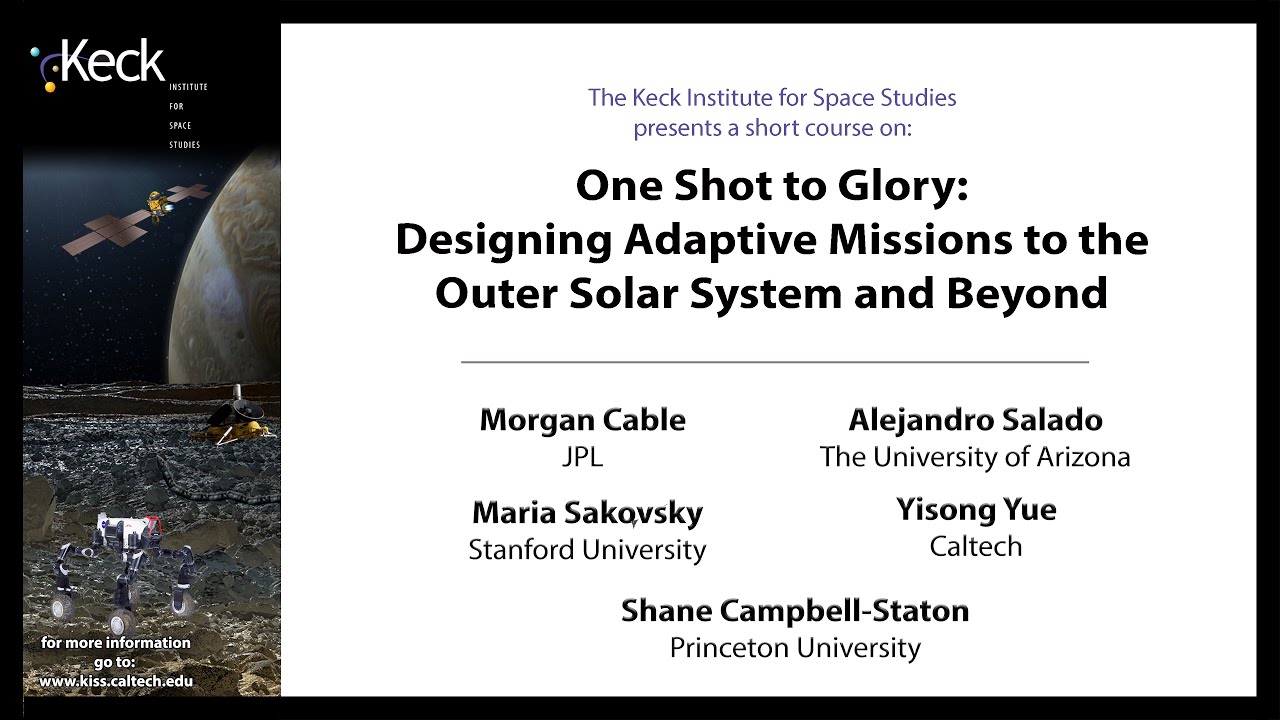
Talk 1 – “Unsolved Mysteries in the Outer Solar System” – Morgan Cable, JPL
- Science goals and capabilities of current NASA, ESA, JAXA missions to explore the outer planets: Europa Clipper, Dragonfly, JUICE
- Summary of future outer planets mission concepts: Uranus Orbiter and Probe (UOP), Enceladus Orbilander, L4 Enceladus Orbiter + Lander, Enceladus NF concepts, Triton Discovery/NF concepts
- Unanswered science questions that future mission concepts may address in the next ~50 years
Talk 2 – “Systems Engineering Challenges for Designing Adaptive Systems” – Alejandro Salado, The University of Arizona
- Fundamentals of Systems Engineering
- Challenges posed by a one-shot mission
- System engineering approaches for a one-shot mission
Talk 3a – “Adaptive Robotic Technologies 1: Hardware” – Maria Sakovsky, Stanford University
- Expanding spacecraft functionality using adaptive hardware
- Overview of emerging technologies for adaptive structures
- Unsolved challenges: sensing, actuation, and control
Talk 3b – “Adaptive Technologies 2: Intelligence” – Yisong Yue, Caltech
- Challenges in adaptive robotic intelligence
- Overview of emerging technologies for adaptive intelligence and example use cases (terrestrial and space)
- Unsolved challenges and future work
Talk 4 – “Biological Insight Into Space Systems Design” – Shane Campbell-Staton, Princeton University
- Critical differences between engineering and evolutionary approaches to system design and developing a unified transdisciplinary framework
- Biological mechanisms and post hoc expansion of perceivable action possibilities
- Inspiration from biology for space systems engineering
Short Course Presentations
| Speaker | Affiliation | Presentation |
|---|---|---|
| Hiro Ono | JPL | Introduction (.pdf) |
| Morgan Cable | JPL | Unsolved Mysteries in the Outer Solar System (.pdf) |
| Alejandro Salado | The University of Arizona | Systems Engineering Challenges for Designing Adaptive Systems (.pdf) |
| Maria Sakovsky | Stanford University | Adaptive Robotic Technologies 1: Hardware (.pdf) |
| Yisong Yue | Caltech | Adaptive Robotic Technologies 2: Intelligence (.pdf) |
| Shane Campbell-Staton | Princeton University | Biological Insight Into Space Systems Design (.pdf) |