



Workshop Overview:
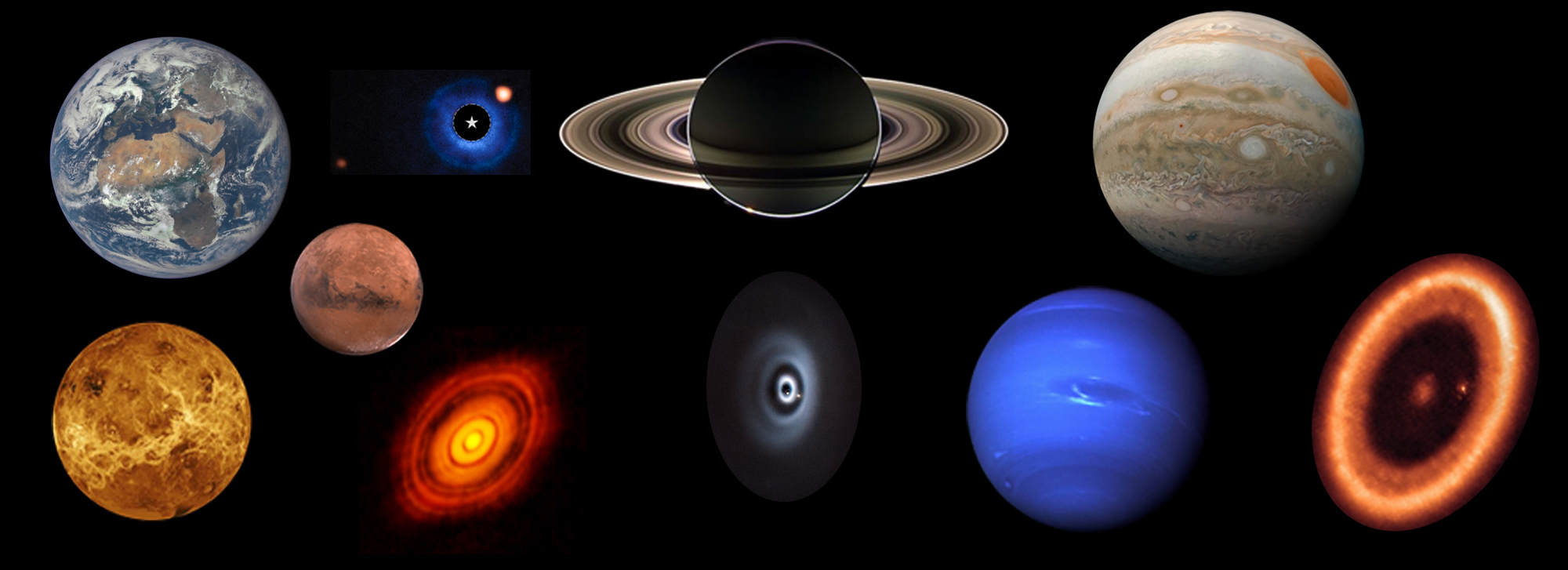
The primary objective of the workshop is to compare exoplanets with the planets within our solar system to advance the understanding of planetary systems in general. Exoplanets provide a broad context for the study of what is unique vs common for the planets within our solar system as well as providing observations of planetary systems across various stages of evolution. The planets within our solar system can be studied in more detail and thus provide planetary templates for interpreting the relatively sparse exoplanet data. A key objective of the workshop is to identify future exoplanet observables and solar system mission measurements that will enable significant progress and synergy between the two fields of study. Three focus areas for the first week of the workshop are giant planetary interiors, giant planetary atmospheres, and future missions.
1. Formation of giant planets. In our solar system we have four such bodies, two of which have been intensively studied. We have some clues on origin (e.g., meteoritics and internal structure). But we have no time machine. In other systems we have the prospect of learning about early stages by looking at young planets. This is beginning to happen, but it can benefit greatly from what we are learning from our system. Uranus and Neptune have very different heat flows (and mildly different compositions) and there are good reasons to think that this is related to origin. Jupiter and Saturn have different levels of distended heavy element distributions (i.e., no traditional cores) and there again the suspicion that this is related to origin. Direct imaging (i.e., IR, e.g. JWST) can help identify what happens when these bodies form. Key outstanding questions include the possibility of merging events such as giant impacts (evidence for this has been discussed for both Jupiter and exoplanets), the role of disk instabilities, and what observations can be made to better understand formation, both for our planets and for exoplanets.
2. Planetary atmospheres and late Infalls. It is common in the exoplanet community to suggest planetary atmospheric compositions allows inference of the interior. Reviews exist that question whether this concept is valid (Lichtenberg et al., 2025), however, these reviews illustrate a general tendency of the community that our proposed workshop will further examine. Our own solar system suggests otherwise (the atmospheres of Jupiter, Saturn, Uranus and Neptune may have been polluted from outside after formation. The role of small bodies is key to this question. What can exoplanet observations tell us about small bodies (including dust or zodiacal and recent and current interstellar visitors)? State-of-the-art exoplanet observations now provide a set of robust, directly measurable properties for giant exoplanets that can be meaningfully compared to Juno’s constraints on Jupiter. For example: hot and warm Jupiters, transmission and emission spectroscopy from JWST routinely yield atmospheric metallicities, elemental ratios e.g. C/O, molecular abundances (H₂O, CO, CO₂, CH₄), cloud properties, and signatures of disequilibrium chemistry and vertical mixing. These and other techniques define a grounded set of diagnostics that can be compared spacecraft results within our solar system to explore metallicity, elemental ratios, disequilibrium chemistry, vertical mixing, thermal structure, and global circulation.
3. Key Outstanding Questions: Future Mission Science and Measurement Objectives The workshop report will serve as a mini-decadal study for the fields of Exoplanet and Solar System science. The report will summarize current knowledge of and identify key outstanding questions which have the potential for significant progress to be achieved through the collaboration of scientists from both fields. The set of key outstanding questions will serve to develop a set of science and measurement objectives for future missions for exploration within our solar system as well as future telescopes and missions to study exoplanetary systems.
This study is co-funded by the Caltech Center for Comparative Planetary Evolution.