Workshop Overview:
This study will evaluate the science case for, and feasibility of, returning samples from the surface, atmosphere, and/or plumes of planetary bodies all across the Solar System, from Mercury to Kuiper Belt Objects beyond Pluto’s orbit.
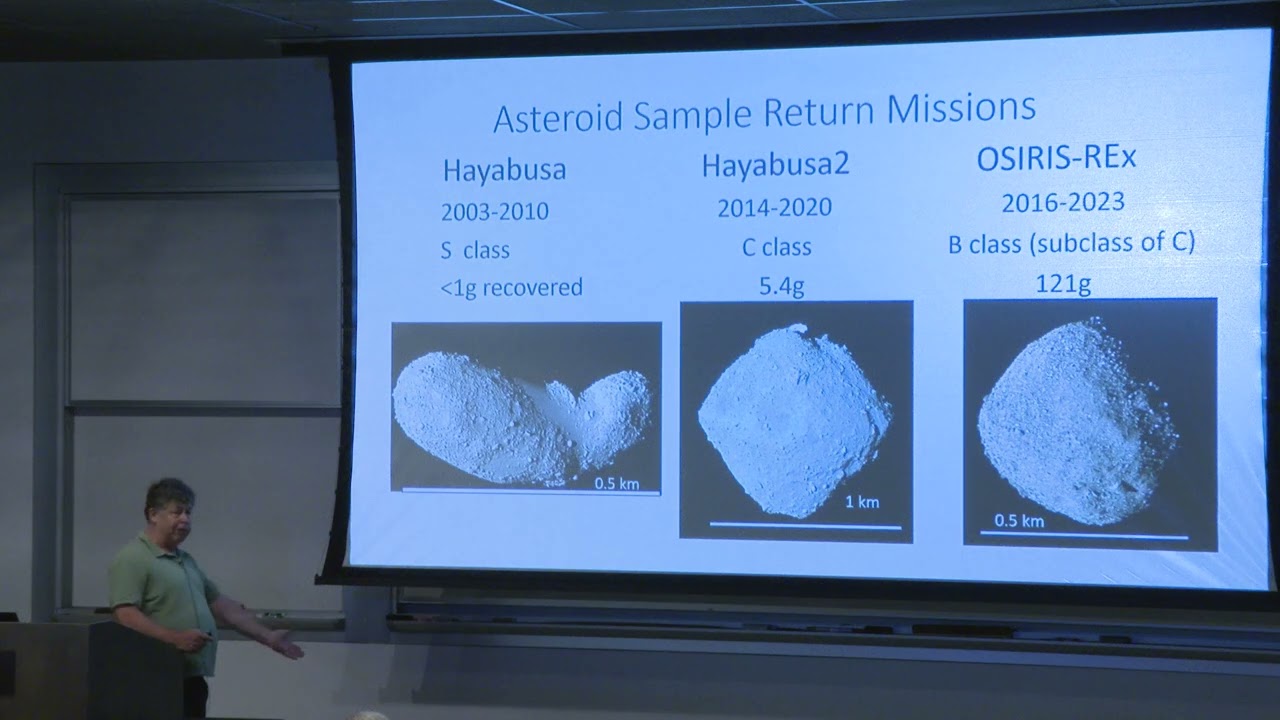
The planetary science community has fully entered the era of sample return from planetary bodies, following the recent successes of the Japan Aerospace eXploration Agency (JAXA) Hayabusa 1 & 2 missions and NASA’s Origins, Spectral Interpretation, Resource Identification, and Security – Regolith Explorer (OSIRIS-REx) mission. The Origins, Worlds and Life (OWL) Planetary Decadal Survey for the current 2023-2032 decade furthermore placed a very strong emphasis on sample return missions. Mars Sample Return is considered the highest priority mission for this decade. Sample return missions from the surface of a comet nucleus, and from Ceres, are among targets for upcoming rounds of New Frontiers missions.
Recent rocket technology advances (e.g. NASA’s Space Launch System or the ongoing development of SpaceX’s Starship), as well as emerging in-flight nuclear propulsion technologies (nuclear thermal propulsion, nuclear electric propulsion) will, when combined, enable the launch of spacecraft with sufficient propulsive power to reach previously unforeseen destinations with enough resources to carry a landed sampling platform and return samples back to Earth within a much shorter timespan than previously achievable.
Through this Study Program we anticipate ultimately arriving at a prioritized list of solar system targets for sample return missions for decades to come, based on the expected science return and technology readiness, and may provide recommendations for technology developments needed to enable such missions.
The objectives for this workshop will be to:
- Review enabling propulsion technologies and mission design options
- Review the scientific achievements of past sample return missions, and scientific objectives of publicly available sample return mission concepts
- Leverage the strategic research / missions recommended for each potential type of target by the Origins, Worlds and Life Decadal Survey
- Discuss for each target type the comparative scientific value of analyses of returned samples vs. remote sensing and/or in-situ measurements.
A key outcome of the workshop will be to determine preliminary requirements on number of samples, sample acquisition, sample integrity and preservation during return, sample curation and processing, and sample analysis.
Team Leads
-
Jet Propulsion Laboratory, California Institute of Technology
-
California Institute of Technology
-
University of Hawai'i


The study program schedule is available in .pdf here
- Aanu Adeloye — University of Texas at Austin
- Jose Aponte — NASA Goddard Space Flight Center
- Mike Brown — Caltech
- Debra Buczkowski — Johns Hopkins University Applied Physics Laboratory
- Mathieu Choukroun — JPL
- John Eiler — Caltech
- Valentina Forero Fuentes — Hiroshima University
- Anthony Freeman — JPL (Retired)
- Perry Gerakines — NASA Goddard Space Flight Center
- Amy Hofmann — JPL
- Hope Ishii — University of Hawai'i at Mānoa
- Reza Karimi — JPL
- Jennifer Jackson — Caltech
- Yang Liu — JPL
- Jonathan Lunine — JPL
- Karen Meech — University of Hawai'i
- Alexander Meshoulam — Caltech
- Angel Mojarro — NASA Goddard Space Flight Center
- Marc Neveu — University of Maryland/NASA Goddard Space Flight Center
- Ryan Ogliore — Washington University in St. Louis
- Carol Raymond — JPL
- Lee Saper — JPL
- Lori Shiraishi — JPL
- Shogo Tachibana — University of Tokyo
- Francois Tissot — Caltech
- Hikaru Yabuta — Hiroshima University
- Teng Ee Yap — Caltech
- Michael Zolensky — NASA Johnson Space Center